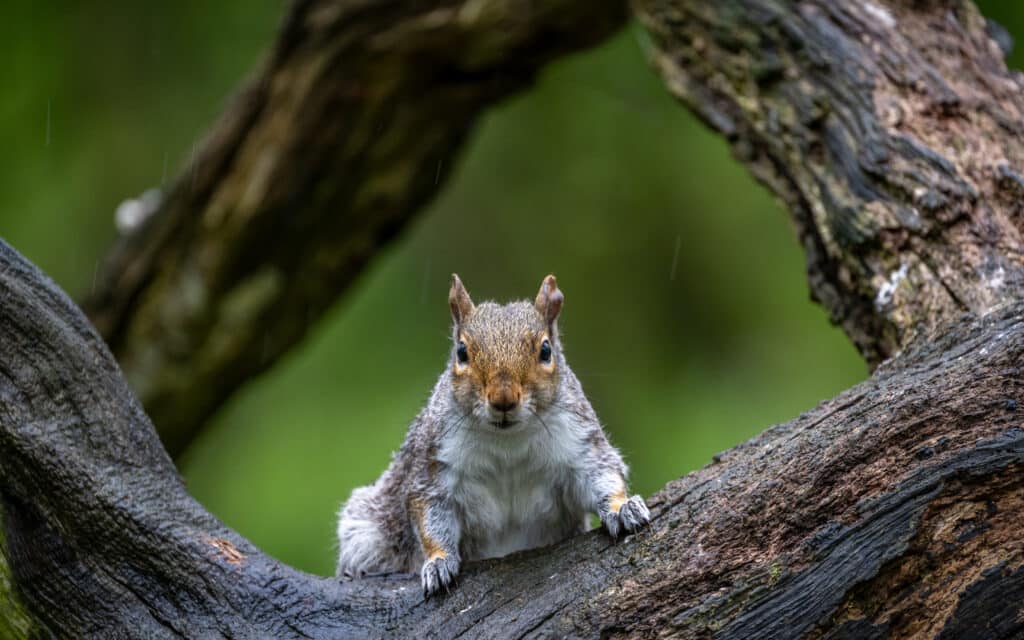
Scratching in the loft, chewed timber and stripped bark on garden trees are the classic signs you need squirrel pest control, and in the UK almost all of this activity comes from the grey squirrel rather than the native, protected red squirrel. Grey squirrels are not a protected species, so they can be controlled using humane, approved methods, but they must never be trapped and released back into the wild. Dealey Environmental’s pest control team helps homes, farms and commercial sites across East Anglia identify which squirrel they are dealing with, and deal with the problem legally.
What Are the Signs of a Squirrel Problem?
Squirrels are rodents, so their front teeth grow continuously and they gnaw to keep them worn down. This habit, combined with their climbing ability, is usually what gives them away.
How Do You Know If Squirrels Are in Your Loft?
- Scratching, scampering or rolling noises in the roof space, often at dawn and dusk
- Chewed timber, joists or roof felt, and stripped insulation around electrical cabling
- Loft insulation or soft material pulled together into a nest
- Droppings similar in size to large raisins near entry points
How Do You Know If Squirrels Are Damaging Your Garden or Trees?
- Patches of bark stripped away, usually higher up the trunk or on branches, exposing pale wood underneath
- Bulbs or plant pots dug up and disturbed
- Bird feeders raided and emptied overnight
- Shallow holes in lawns and borders where nuts have been buried or dug up again
Grey Squirrel or Red Squirrel: Why Does It Matter?
Before treating a squirrel problem, it is essential to know which species you are dealing with, because red squirrels are strictly protected by law and grey squirrels are not.
| Feature | Grey squirrel | Red squirrel |
| Scientific name | Sciurus carolinensis | Sciurus vulgaris |
| Native to the UK? | No, introduced from North America in 1876 | Yes |
| Legal protection | None | Protected under the Wildlife and Countryside Act 1981 |
| Estimated population | About 2.7 million in Great Britain | About 38,900 in England |
| Where typically found | Most of England, Wales and lowland Scotland | Isolated areas, including the Isle of Wight, Poole Harbour and northern England |
Sources: GOV.UK Forestry Commission and the Defra grey squirrel policy statement.
What Damage Do Grey Squirrels Cause?
Grey squirrel activity is more than a nuisance. It causes measurable harm to trees, buildings and the UK’s native wildlife.
- Bark stripping that can weaken or kill trees, most often in trees aged 10 to 50 years old, with sycamore, beech, oak and several conifer species most at risk
- An estimated £37 million of damage to woodlands in England and Wales every year, covering lost timber value, restocking costs and current control costs
- Gnawing on timber and cabling in loft spaces, which can leave electrical wiring exposed
- Spreading squirrel pox virus to red squirrels, a disease that is usually fatal to reds but rarely affects greys
Grey squirrels do occasionally take eggs and chicks from birds’ nests, but current evidence suggests this happens too rarely to affect the population of most prey species, so this is a smaller factor than the damage they cause to trees and property.
Is It Legal to Control Grey Squirrels in the UK?
Yes. The grey squirrel is not a protected species, so it can be controlled, but any control must follow the Wild Mammals (Protection) Act 1996 and the Animal Welfare Act 2006, both of which require humane treatment.
- You do not usually need a licence to control grey squirrels using legal, humane methods
- A trapped grey squirrel must not be released back into the wild under the Wildlife and Countryside Act 1981; it must be humanely dispatched
- Firearms and air rifles used for shooting require the relevant certificate
- Lethal or kill traps must not be used where red squirrels or pine martens are present or suspected
Are Red Squirrels Protected in the UK?
Yes. The red squirrel is protected under Schedules 5 and 6 of the Wildlife and Countryside Act 1981. It is an offence to intentionally kill or injure a red squirrel, or to damage, destroy or disturb a place it uses for shelter. With only around 38,900 left in England, largely restricted to the Isle of Wight, Poole Harbour and pockets of northern England, anyone unsure which species they are dealing with should get advice before taking any action.
What Are the Approved Methods of Grey Squirrel Control?
- Trapping: live capture traps are preferred, and must be used instead of kill traps wherever red squirrels are present or suspected; traps should be checked at least once a day
- Shooting: air rifles or firearms may be used by someone holding the correct certificate
- Drey poking: used only as a supporting method alongside shooting, not as a stand-alone solution
- Proofing: cutting back overhanging branches and fitting galvanised mesh over vulnerable gaps helps stop squirrels gaining entry to a roof in the first place
Once squirrels have been removed from a loft, contaminated insulation often needs replacing. Our specialist cleaning team can make good the space once our pest control engineers have finished.
When Should You Call a Professional for Squirrel Pest Control?
- Noises or damage are persistent despite your own proofing attempts
- The problem is in a commercial or agricultural building, such as a barn or grain store roof void
- Squirrels are near overhead cabling, or you suspect a red squirrel population nearby
- You want the work carried out to recognised welfare and safety standards, rather than a one-off DIY attempt
We work across Norfolk, Suffolk, Cambridgeshire and Essex, so whether you need pest control in Norwich, Cambridge or Colchester, our engineers are used to identifying squirrel entry points on both period and modern buildings. This applies equally to commercial pest control clients, such as warehouses and grain stores, and not just homes.
Dealey Environmental is a member of the British Pest Control Association. Our approach favours integrated pest management, proofing and prevention over repeat call-outs, so once a squirrel problem is resolved, it tends to stay that way.
Frequently Asked Questions About Squirrel Pest Control
Is it illegal to kill grey squirrels in the UK?
No. Grey squirrels are not protected, but any control must be carried out humanely under the Wild Mammals (Protection) Act 1996 and the Animal Welfare Act 2006.
Can I release a squirrel I have trapped?
No. Under the Wildlife and Countryside Act 1981, a trapped grey squirrel must not be released back into the wild. It must be humanely dispatched.
Are red squirrels protected in the UK?
Yes. Red squirrels are protected under Schedules 5 and 6 of the Wildlife and Countryside Act 1981, making it an offence to kill, injure or disturb them.
Do squirrels pose a fire risk in lofts?
Squirrels gnaw continuously to wear down their teeth, and in a loft this can include electrical cabling, so any exposed or stripped wiring should be checked by a qualified electrician as a precaution.
If squirrels are damaging your loft, trees or commercial property, Dealey Environmental can help you resolve the problem quickly, safely and within the law. Contact us today to speak to one of our pest control specialists.