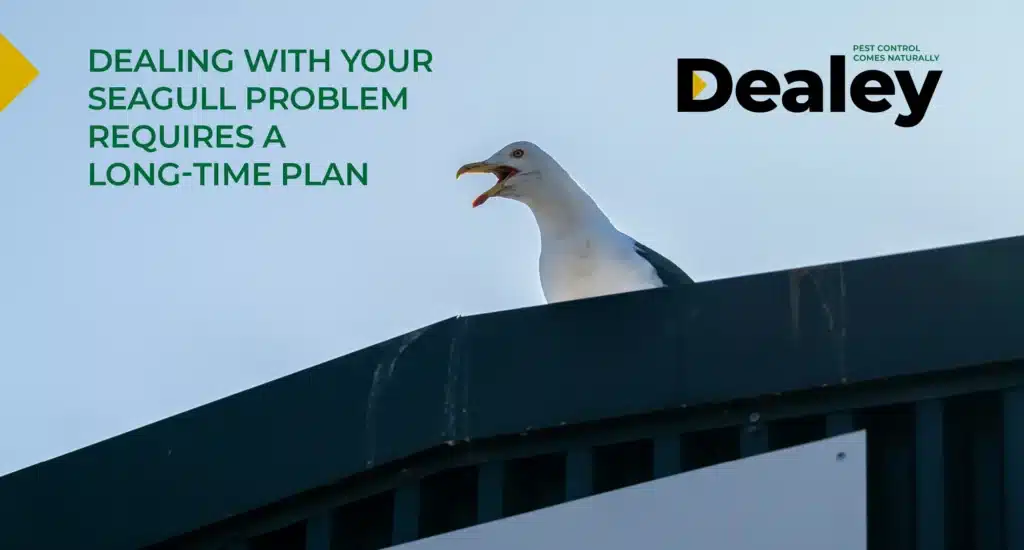
Dealing with your seagull problem requires a long-time plan
It’s that time of year again – when you want to head out to the local picnic site or seaside and enjoy a relaxing time with the family. But your planned day out gets ruined by dive bombers, food stealers and persistent screaming, and we’re not just talking about the kids!
Seagulls can be an absolute pain for commercial properties. They can be aggressive, and relentless and can cause property damage and transmit health risks. If they are not under control, you might find your customers decide they won’t want to deal with these pesky cretins and choose to go elsewhere.
Seagulls are so infuriating, you’re almost certainly planning a dramatic end to them – but before you get carried away, you must understand the legal implications of seagull removal.
Seagulls are a protected species.
Yes, you read that right.
The humble seagull is a legally protected species.
It’s hard to imagine, isn’t it?
These buggers are everywhere and incredibly common, so why are they protected?
Well actually, they aren’t as common as you’d think.
There are 50 different species of seagull in the world, with six species most common in the UK. These include the following –
- Herring Gull
- Lesser Black-backed Gull
- Great Black-backed Gull
- Black-headed Gull
- Common Gull
- Kittiwake
You’re not being gull-ible, and we’re not having you on, we promise.
The birds are actually in serious decline. Last year, the BBC reported “they are on the red list – the highest level – for British bird species of concern because their population has dropped by 72% in 55 years.”
The RSPB also report “Herring Gulls are now considered to be the highest level of conservation concern in the UK, with non-urban populations having declined by 44% over the last 20 years.”
That’s a bit scary to think of, isn’t it? Today’s wildlife is in such a perilous state, even the seemingly common-place creatures are heading towards total doom.
In an ideal world, we need to focus far more on prevention to reduce the likelihood of seagulls impacting your business. That way, you can relax and the bird population isn’t hindered. But of course, we don’t live in an ideal world and there will almost certainly be times when you do need to bring in the experts (that’s us of course!) if you need help to get rid of your seagull problem.
Why are seagulls a problem?
Honestly, if you were going to anthropomorphise a seagull you’d probably use the words “bully” “mean” “bold” “outrageous” or as we prefer, “gossipy, obsessive hoarders!”
Quite frankly, seagulls can be complete and utter s**ts!
There’s a real love them or hate them approach to seagulls, and we get it.
On the positive side, they play a vital role in the ecosystem. They regulate the fish population, prevent any overpopulation of specific marine matters, help to dispose of decaying matter and can help to keep our beaches clean.
On the other hand, they are rude and bolshy. They can be loud and will happily divebomb your kids just to grab a chip! Their constant squawking is unbearable and if they think their nest is under attack they can become incredibly aggressive. They can also carry diseases like salmonella and E. coli.
You need a licence to deal with seagulls – preparing now could help you for next year’s seagull issue.
You’re not going to like what we have to say about the licensing situation.
But if you’ve got a seagull problem this year, it’s pretty much impossible to get a licence to deal with this year’s flock.
We know. We know…. it’s a total pain in the backside. However, considering how threatened seagulls are right now, it makes sense you need to document everything and prove you’ve invested in humane deterrents before escalating your efforts into a death sentence.
So here’s a quick low down of the steps you need to put into place now, which will help you for next year’s problem.
Who will grant the seagull removal licence?
Your first step is to discover who will grant your licence. This will depend on where you are in the UK – licences are not transferrable between nations.
You must follow the relevant process and legal requirements for the country in which you intend to act.
| Nation | Authority | What do you need to do? |
| England | Natural England | Apply for an A08/A09 licence; provide documented evidence of the problem; demonstrate you’ve tried non-lethal methods first; identify if you need an individual licence. |
| Wales | Natural Resources Wales | Check general/individual licences; provide documented evidence of the problem; be aware protected sites need individual licences. |
| Scotland | NatureScot | Specific licence only; you must document a strong justification of the problem; demonstrate you’ve tried non-lethal methods first; be aware fewer licences are issued. |
| Northern Ireland | NI Environment Agency | Some gulls can be culled under general licences; otherwise individual application; and local council fees will apply. |
There are huge risks of failing to comply with the licensing restrictions. Seagulls are protected under the Wildlife and Countryside Act 1981, so dealing with the problem yourself could put you at risk of prosecution (risking at least six months in prison) and a potential £5,000 fine.
Although the granted licence needs to be in your name, we can help you with the paperwork and evidence collection – all you’ve got to do is ask.
General Licences (GL41 & GL42) or Individual Licences (A08 & A09) – what do I need?
Now you know WHO grants the licences, you need to think about WHAT licence you need.
Typically, you have the option of a general licence or an individual licence.
A general license is normally issued to allow ‘authorised persons’ to take specific actions without needing to apply for individual licences. These general licences are only eligible for specific species of wild birds and methods of removal – if the gull species you want to remove is not on the list (and there’s a very strong chance it won’t be), you will need to apply for an individual licence.
Side note – This is another area where we can help – our bird team has excellent laser vision and can easily identify what species of gull is getting on your nerves.
An individual licence is granted when the species or removal method is not covered under the general licence.
| Licence Type | Purpose | Does it cover seagull species | When you can apply for a licence according to Gov.uk |
| GL41 | Public health/safety | Potentially not | “A land owner, occupier or authorised person, use this general licence to kill or take certain wild birds to preserve public health or safety.” |
| GL42 | Agricultural/livestock damage | Potentially not | “This licence allows an authorised person to carry out activities in relation to certain species of wild birds the permitted target species to prevent serious damage to livestock, foodstuffs for livestock, crops, vegetables, fruit, fisheries or inland waters.” |
| A08 | Any (with strong justification) | Yes | You must only apply for an A08 or A09 licence to control wild birds by killing, taking or disturbing them for the purpose of:
|
| A09 | Any (with strong justification) |
Applying for a licence will take several months.
The step-by-step process for licence application will take a long time – even once you’ve collated all the evidence and filled in the paperwork, it could take up to 30 days for your application to be processed.
That’s why we’re thinking ahead to next year. Our bird removal experts are adamant they are always one step ahead of the seagulls – everyone else just calls it being overly prepared!
Starting the process now will allow you the time to compile a dossier of evidence showing what ratbags the seagulls truly are. You’ll be able to show a) what damage they are causing and b) what steps you’ve taken to encourage them to nest elsewhere. Applying for a licence to kill wild birds should only ever be a last resort which is why it takes so long.
Our team will be here every step of the way to help you with your licence application. From species identification to evidence collection and even filling in the paperwork, we can work with you to help you protect your commercial property from seagulls.
Step One – collecting the right evidence that seagulls are causing irrefutable harm
You can only apply for an A08 or A09 licence to prevent damage to livestock or animal feed, disease prevention, public health and safety, animal conservation or air safety.
Unfortunately, if your only reason for applying is that a flock of seagulls is p*****g you and your customers off, that won’t be considered a valid reason and you will be rejected. We’re sorry to be the bearer of bad news!
Our team of bird removal experts can work with you to collect the evidence you need. To get you started, we’ve listed some of the things you can do below. See, aren’t we a helpful bunch!
| Reason for the licence | What evidence do you need? |
| Preventing serious damage | Photos or videos of the damage and proof it was undertaken by the seagulls.
Written records or diary observations (how often the birds attack, numbers of livestock or the extent of crops damaged). Financial records show what losses were incurred as a result of the birds. Records of the size of the local bird flock, such as counts or estimates of birds visiting or roosting on site. Detailed statements explaining how the birds’ behaviour causes the damage. |
| Preventing the spread of disease | Collate evidence of positive test results showing disease-causing bacteria or viruses in livestock, feed or other areas. You must show that they are linked to the wild bird species.
Photos or videos showing the risk of a disease spreading. Include advice from qualified professionals (e.g. a vet) that the disease is spread by the birds. Records of the size of the local bird flock, such as counts or estimates of birds visiting or roosting on site. Detailed statements explaining how the birds’ behaviour causes or creates a high risk of spread of disease. |
| Preserve public health or safety. | Detailed accident, incident, and near-miss logs.
If the problem relates to technical, structural or electrical risks you may need a written report from an engineer or other relevant professional. Within your submission, you can also include statements, diaries, complaints, repair or maintenance receipts or invoices to highlight how often the risks are occurring. Photos or videos demonstrating the risk. |
| Animal or plant conservation | Detailed nesting statistics.
Diary observations. Detailed statements and monitoring results of monitoring by local wildlife groups or other suitably experienced individuals such as an ecologist or qualified conservation staff. |
| Preserve air safety | Proof wild birds are present within the ‘risk area’ on or near your aerodrome.
Detailed statements explaining the behaviour of the birds and the types of air safety risks it could cause for your aerodrome Documentation counting or estimating the numbers of birds of each species that are causing a risk. |
Step two – documenting the steps you’ve taken for humane deterrents
Now you’ve collected your evidence to show what havoc the seagulls are creating, you also need to document what you’ve done to encourage them to move on and nest elsewhere.
Moving straight to the detonate button is never going to impress those who are granting licences, so you need to simultaneously show what humane efforts you’re making to deter the gulls.
Options you might want to consider include:
- Providing cover or refuge for animals/wildlife at risk of the seagulls.
- Providing PPE or safety measures to protect risks to public safety (ideal for those working at height near nesting areas).
- Installing physical barriers or deterrents to stop birds from accessing specific areas and to prevent disease from spreading to livestock.
- Physical proofing, netting, or spikes on buildings can discourage birds from roosting or nesting, minimising any risks to air safety.
Ideally, you need your evidence to show the deterrents aren’t having any long-term impact. That’s why you need to maintain your records over several months.
Rely on Dealey to get you prepared for next year’s flock
We’ve thrown a lot of information at you here. There’s a lot to consider and we’re not lawyers, but even we know the risks of falling fowl of wild bird removal licences are not worth taking.
Don’t leave your bird removal to chance. Talk to our seagull experts – we’ll take you through everything step-by-step to make sure your business is protected, you are legally abiding by the rules and that eventually, those bloody seagulls will be a distant memory!